

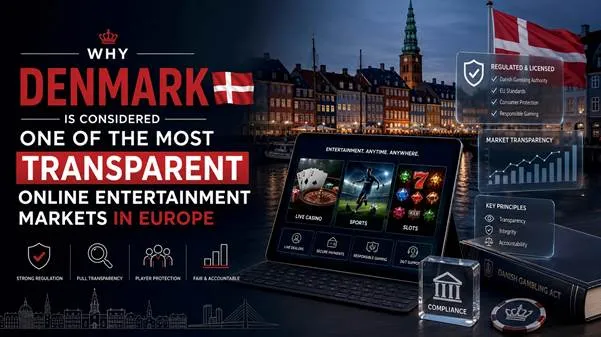
Denmark has earned a reputation as a benchmark for clarity, fairness, and accountability in the online entertainment sector. Long before many of its European neighbours modernised their frameworks, Denmark opened its market under a licensing model that prioritised consumer safety over quick revenue. For players who want to understand how this well-organised environment works, resources such as DanskSpiller offer a helpful window into the licensed operators and the rules that govern them.
What makes the Danish approach stand out is not a single regulation but a whole ecosystem of oversight, public reporting, and player-focused tools. Together, these elements create a market where users know exactly who they are dealing with and what protections apply to them.
A Regulated Market Built on Trust
Denmark liberalised its online entertainment market on 1 January 2012, replacing a state monopoly with an open licensing system. This decision was deliberate: rather than leaving players exposed to unregulated offshore sites, the government created a legal, supervised space where competition could thrive under strict conditions. The result is a market where legitimacy is easy to verify and where the rules are written to protect the consumer first.
The Role of Spillemyndigheden
At the centre of this system sits Spillemyndigheden, the Danish Gambling Authority, which operates under the Ministry of Taxation. Its responsibilities go far beyond issuing licences. The authority monitors operators continuously, investigates complaints, publishes guidance, and takes enforcement action when rules are broken.
Crucially, Spillemyndigheden communicates openly with the public. It maintains an accessible register of licensed operators, publishes statistics on market activity, and issues clear warnings about unlicensed sites. This willingness to share information is one of the main reasons Denmark scores so highly on transparency.
Licensing and Accountability
Obtaining a Danish licence is not a formality. Operators must demonstrate financial stability, technical reliability, and a genuine commitment to responsible play before they are approved.
Clear Requirements for Operators
● Verified identity checks and strong anti-money-laundering procedures.
● Certified, independently tested gaming systems to guarantee fair outcomes.
● Mandatory display of licence information and responsible-play messaging.
● Regular reporting to the authority on financial and operational activity.
Because these obligations are public knowledge, players can hold operators accountable and quickly spot any site that fails to meet the standard.
Player Protection Tools
Transparency in Denmark is reinforced by practical safety mechanisms that any user can access. Two of the most important are national systems available across every licensed platform.
● ROFUS – a central self-exclusion register that lets players block themselves from all licensed sites temporarily or permanently.
● StopSpillet – a free national helpline offering confidential support and guidance.
The fact that these tools are centralised, rather than left to individual operators, means the same protections apply everywhere. A player never has to wonder whether a specific site takes safety seriously.
Transparent Taxation and Advertising Rules
Denmark also stands out for the clarity of its financial and marketing framework. Licensed operators pay a defined gambling duty on their gross gaming revenue, and these arrangements are documented publicly. Advertising is tightly controlled to prevent misleading claims and to shield vulnerable groups, particularly minors. Every promotion must be truthful, clearly labelled, and accompanied by responsible-play information.
How Denmark Compares
|
Transparency Factor |
Danish Approach |
|
Regulator |
Independent authority under the Ministry of Taxation |
|
Operator list |
Public, searchable, regularly updated |
|
Self-exclusion |
National system covering all licensed sites |
|
Advertising |
Strictly regulated and clearly labelled |
|
Reporting |
Ongoing disclosure to the authority |
Conclusion
Denmark’s status as one of Europe’s most transparent online entertainment markets is no accident. It is the product of a carefully designed licensing model, an open and active regulator, centralised player-protection tools, and clear rules on taxation and advertising. For consumers, this means a rare combination of choice and confidence: they can enjoy a competitive market while knowing that every licensed operator is held to the same high, publicly visible standard. That balance of freedom and accountability is exactly what other European markets continue to study and, increasingly, aspire to match.
Frequently Asked Questions
Which authority regulates the online entertainment market in Denmark?
The market is supervised by Spillemyndigheden, the Danish Gambling Authority, which operates under the Ministry of Taxation. It issues licences, monitors operators, handles complaints, and publishes public guidance and statistics.
How can I check whether an operator is licensed in Denmark?
Spillemyndigheden maintains a public, regularly updated register of every licensed operator. Legitimate sites also display their licence details openly, so you can confirm their status before creating an account.
What is ROFUS?
ROFUS is Denmark’s national self-exclusion register. It lets players block themselves from all licensed sites at once – either temporarily or permanently – rather than having to do so operator by operator.
Is help available for players who need support?
Yes. StopSpillet is a free national helpline that offers confidential support and guidance. Because it is centralised, the same assistance is available regardless of which licensed platform a player uses.
Why is Denmark considered more transparent than many other European markets?
Denmark combines an open licensing model, an active and communicative regulator, centralised player-protection tools, and clear rules on taxation and advertising. Because so much information is made public, players can easily verify who they are dealing with and what protections apply.
Are advertising and bonuses regulated?
Yes. All promotions must be truthful, clearly labelled, and accompanied by responsible-play information. Marketing is tightly controlled to prevent misleading claims and to protect vulnerable groups, especially minors.