
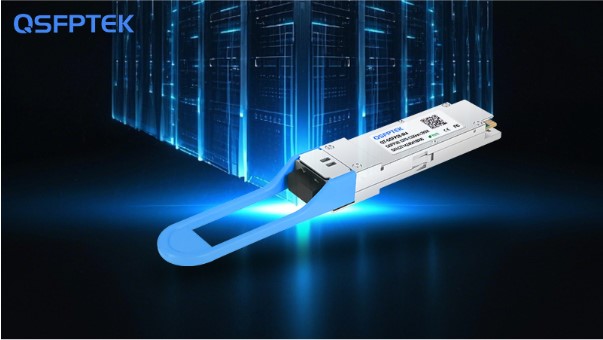

As enterprise networks continue to grow in scale and complexity, core and aggregation layers are under increasing pressure to handle more traffic. Virtualization, private cloud platforms, centralized storage, and east-west data flows have significantly increased bandwidth demands inside enterprise environments. While 10G and 40G once met these needs, many organizations are now turning to 100G connectivity to maintain performance and headroom for future growth.
Within this context, 100G IR4 has emerged as a practical option for enterprises looking to upgrade core and aggregation links without introducing unnecessary complexity.
Why 100G IR4 Fits Enterprise Core Requirements
Enterprise core networks typically connect data center switches, aggregation nodes, and key network services across distances longer than short-reach optics can support, but shorter than metro-scale links. With a reach of up to 2 km over single-mode fiber, 100G IR4 fits squarely into this distance range.
Unlike SR4, which relies on multimode fiber and is limited to short distances, IR4 supports existing OS2 single-mode infrastructure commonly found in enterprise backbones. At the same time, it avoids the higher cost, power consumption, and operational overhead associated with longer-reach solutions such as ER modules.
Balancing Performance and Operational Simplicity
One of the main advantages of 100G IR4 in enterprise environments is its balance between performance and simplicity. IR4 uses standard LAN-WDM wavelengths and integrates seamlessly with widely deployed 100G switch platforms. From an operational perspective, it behaves much like other pluggable optics, requiring no additional tuning, external amplification, or specialized monitoring.
This simplicity is especially important at the core and aggregation layers, where stability and predictability are critical. Network teams can deploy IR4 links with confidence, knowing that the technology is mature and well supported across vendors.
Supporting Aggregation Layer Scalability
At the aggregation layer, multiple access switches converge into higher-capacity uplinks. As access speeds increase to 10G and 25G, aggregation links must scale accordingly. 100G IR4 provides enough bandwidth to consolidate multiple lower-speed connections while maintaining low latency and high availability.
Because IR4 operates over single-mode fiber, it also supports flexible physical layouts. Aggregation switches can be placed in centralized network rooms or separate buildings without worrying about distance limitations that often constrain multimode solutions.
Cost and Power Considerations for Enterprises
From a cost perspective, 100G IR4 sits in a favorable position. It is more affordable and power-efficient than long-reach 100G optics, while offering significantly more flexibility than short-reach alternatives. For enterprises managing tight IT budgets, this balance can make a meaningful difference when scaling network capacity.
Power consumption is another important factor at the core layer, where multiple high-speed ports are densely populated. Compared to ER modules, IR4 typically generates less heat, easing cooling requirements and improving overall system efficiency.
Planning for Future Growth
Enterprise networks rarely upgrade on a single timeline. Core and aggregation layers must support both current workloads and future expansion. By deploying 100G IR4, organizations create a solid foundation that can accommodate growth without frequent reconfiguration.
IR4 also allows enterprises to standardize on a consistent optical solution for medium-distance links, simplifying inventory management and reducing operational complexity over time.
Conclusion
100G IR4 is well suited for enterprise core and aggregation layers where distances extend beyond short-reach limits but do not require long-haul optics. By offering a balanced combination of reach, performance, cost efficiency, and operational simplicity, IR4 enables enterprises to upgrade their networks in a controlled, future-ready manner—without overengineering the solution.
