
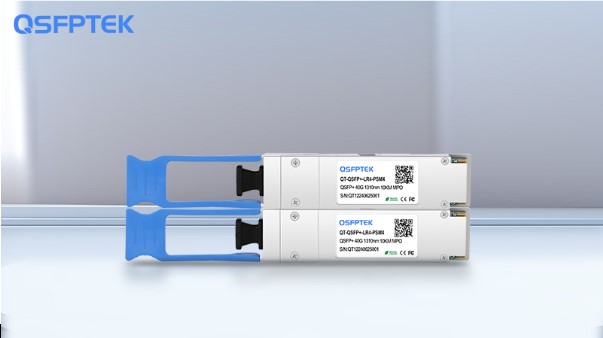

As data centers continue to scale, bandwidth demands are increasing rapidly due to virtualization, distributed cloud applications, and the continuous growth of east-west traffic. Many operators who previously relied on 10G infrastructure are now considering pathways to migrate toward higher-capacity links. Among the available 40G technologies, the 40GBASE-PSM4 QSFP+ 1310nm 10km MTP/MPO optical transceiver module has become one of the simplest and most practical upgrade options. Its parallel single-mode architecture, straightforward cabling requirements, and long-reach capability make it a natural evolutionary step for networks built on traditional duplex single-mode fiber. With a design that balances performance, compatibility, and cost, PSM4 offers a smooth and efficient transition for data centers seeking to expand their capacity without restructuring their entire optical plant.
Why Transitioning from 10G to 40G Is Becoming Essential
Modern data centers are dominated by workloads that demand consistent high throughput and low latency, especially in cloud environments where applications communicate across multiple nodes. Legacy 10G links can restrict performance, particularly in dense server environments where each rack generates significant traffic. As applications become more distributed, the pressure on aggregation and spine-leaf interconnects continues to rise. Without upgrading link speeds, operators risk congestion, application delays, and reduced scalability. Moving from 10G to 40G therefore becomes necessary not only to improve bandwidth, but also to maintain predictable performance in modern network topologies. PSM4 modules, with their ability to deliver 40G capacity over existing single-mode fiber and support up to 10 km transmission, address these challenges effectively and offer a seamless path toward higher-bandwidth infrastructures.
Understanding the Parallel Optical Architecture of PSM4
The 40GBASE-PSM4 QSFP+ module uses a parallel optical system based on four independent transmit channels and four receive channels. Each channel operates at 10 Gbps over single-mode fiber, creating a combined aggregate data rate of 40 Gbps. These channels run in parallel through an MTP/MPO connector that terminates eight fibers: four dedicated to transmitting and four to receiving data. This architecture offers a more direct approach to achieving 40G speeds compared with wavelength-division solutions such as LR4, which multiplex multiple wavelengths into a single fiber pair. Because PSM4 avoids the need for advanced CWDM filtering technologies, it is more cost-efficient and has lower optical complexity. The use of standard 1310 nm lasers reduces dispersion and maintains signal integrity over long distances, ensuring the module can reach up to 10 km on standard single-mode fiber. This straightforward design is key to understanding why PSM4 is considered one of the simplest migration paths from 10G.
PSM4 and 10G Cabling Compatibility
One of the most compelling advantages of PSM4 is its alignment with existing single-mode fiber ecosystems. Many data centers that deployed 10G networks originally used LC duplex OS2 cabling, typically arranged in structured pathways and concealed within overhead trays or underfloor systems. While PSM4 requires MTP/MPO connectivity, it remains fully compatible with the same single-mode fiber type and does not require the specialized parallel multimode fibers needed for SR4 solutions. This means that operators can continue to use their existing SMF infrastructure and simply introduce MTP/MPO breakout or conversion modules where necessary. The familiarity of single-mode fiber significantly reduces deployment complexity, making the shift to PSM4 far more manageable than technologies that require entirely different cabling types. As a result, organizations can scale capacity without re-engineering their entire optical network.
The Role of 1310 nm Transmission in Ensuring Long-Reach Performance
PSM4’s reliance on the 1310 nm wavelength range is critical to its ability to support 10 km transmission. Operating in this optical window allows the module to minimize chromatic dispersion and maintain low attenuation over long distances. This characteristic aligns with the behavior of traditional 10G long-reach optics, which also utilize the 1310 nm region to preserve the quality of high-speed signals. Because PSM4 uses four parallel channels at this wavelength, it combines the proven stability of 1310 nm optics with the performance advantages of parallel transmission. This design ensures that PSM4 remains reliable and predictable in diverse environmental and architectural conditions, whether deployed within a single data hall or used to interconnect multiple buildings across the same campus.
Why PSM4 Provides the Easiest Migration Path Compared with LR4
When considering the transition from 10G to 40G, operators often compare PSM4 with LR4 because both enable long-distance transmission over single-mode fiber. However, PSM4 presents a simpler, more accessible upgrade path. LR4 modules require advanced wavelength-division multiplexing components such as multiplexers and demultiplexers integrated within the transceiver. These components increase cost and introduce additional points of optical complexity. PSM4 avoids these requirements entirely by utilizing parallel lanes, making it inherently more cost-efficient and easier to manufacture. Additionally, PSM4’s MTP/MPO interface supports high-density cabling environments and is well suited to structured cabling systems that already incorporate MPO components for 40G and 100G deployments. Because of its parallel design and simplified optical structure, PSM4 modules deliver long-reach 40G transmission without the expense and intricacy often associated with LR4 solutions.
Deployment Flexibility in Spine-Leaf and Aggregation Networks
The increasing adoption of spine-leaf topologies in data centers drives the need for high-capacity, parallel optical solutions. PSM4 fits naturally into this architectural model by providing consistent bandwidth and predictable performance across multiple uplinks. Whether connecting leaf switches to spine switches or aggregating multiple access-layer devices, PSM4 ensures low latency and stable throughput. Its 10 km reach offers considerable flexibility in switch placement, enabling operators to distribute compute resources across rows, halls, and even separate buildings without sacrificing link performance. This adaptability is especially beneficial for expanding data centers, where uniform 40G interconnects can simplify network design and improve operational efficiency across the entire infrastructure.
Cost-Effectiveness and Long-Term Viability
Despite advancements in 100G and 400G technologies, many organizations continue selecting 40G PSM4 as a strategic step in their upgrade roadmap. Its low cost, simplicity of deployment, and compatibility with existing single-mode fiber make it a financially practical choice. Because PSM4 does not require major infrastructure changes, it significantly reduces both capital expenditure and operational disruption. Even as higher-speed technologies become more accessible, 40G continues to serve as a reliable and widely supported standard for enterprise-level and medium-scale cloud networks. PSM4’s balanced performance and affordability ensure that it remains a viable long-term solution for operators aiming to enhance network capacity while maintaining budget control.
Conclusion
Upgrading from 10G to 40G is a crucial step for data centers striving to meet the demands of modern, high-density computing environments. The 40GBASE-PSM4 QSFP+ 1310nm 10km MTP/MPO optical transceiver module provides the simplest and most cost-effective migration path by combining a parallel transmission architecture, 1310 nm long-reach capability, and compatibility with existing single-mode fiber infrastructure. Its straightforward optical design, deployment flexibility, and operational reliability make it an ideal choice for organizations seeking a smooth and efficient transition to higher bandwidth. As networks continue evolving, PSM4 remains a practical and technically sound solution for enabling scalable and future-ready 40G connectivity.
