
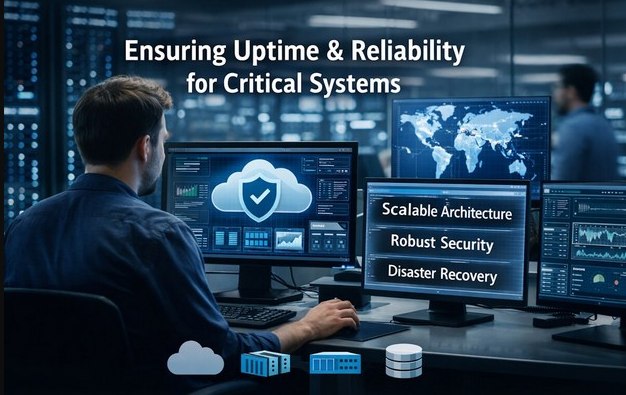

When your application cannot afford downtime, things change.
It’s no longer just about building features. It’s about stability. Reliability. Consistency under pressure. Whether you’re running a fintech platform, healthcare system, logistics network, or enterprise SaaS product, you already know the stakes. A few minutes of downtime can mean lost revenue, damaged trust, and support tickets flooding in.
So the question becomes simple.
Can your tech stack handle that kind of responsibility?
For many organizations, the answer has been .NET. And not by accident.
Let’s break down how .NET supports high-availability and mission-critical systems in real-world scenarios, and why businesses continue to rely on it when failure is not an option.
Built for Stability from the Core
High availability starts at the foundation.
.NET runs on a managed runtime environment. That means memory management, garbage collection, and exception handling are handled systematically. You’re not leaving resource management up to chance.
Memory leaks? Crashes due to unmanaged allocation? Those risks are significantly reduced.
The Common Language Runtime keeps applications stable under load. It isolates processes and monitors execution. If something breaks, it doesn’t always bring the entire system down.
That matters when uptime is tied directly to revenue.
Cross-Platform and Cloud-Ready
Modern mission-critical systems rarely live on a single server in a back office.
They run in the cloud. Across containers. In distributed environments.
.NET Core, now unified into modern .NET versions, supports Windows, Linux, and macOS. This flexibility allows businesses to deploy across multiple cloud providers or hybrid environments.
You can run your applications inside Docker containers. You can orchestrate them with Kubernetes. You can distribute workloads across regions to avoid single points of failure.
When one instance fails, traffic reroutes.
Users barely notice.
That’s the kind of resilience serious businesses need.
Built-In Support for Load Balancing and Scalability
High availability doesn’t just mean staying online. It means performing well during traffic spikes.
.NET applications integrate smoothly with load balancers and reverse proxies. Whether you’re using Azure Load Balancer, AWS Elastic Load Balancing, or on-premise solutions, .NET apps scale horizontally without complex reconfiguration.
Need more capacity?
Spin up more instances.
Your application can handle concurrent requests efficiently thanks to asynchronous programming support. Async and await patterns allow better resource usage, especially in high-traffic APIs.
The result?
Systems that don’t choke under pressure.
Strong Support for Microservices Architecture
Monolithic applications often struggle in mission-critical environments. One failure can impact everything.
.NET supports microservices architecture using ASP.NET Core and lightweight APIs. You can break large systems into smaller, independent services. If one service experiences issues, others keep running.
That isolation reduces risk.
It also allows teams to deploy updates independently without affecting the entire system.
For businesses that require constant uptime, this structure offers a practical path forward.
Enterprise-Grade Security
Security gaps can lead to outages just as easily as technical failures.
.NET includes built-in authentication and authorization frameworks. Role-based access control, claims-based identity, OAuth support, and integration with identity providers are available out of the box.
Data protection APIs help encrypt sensitive information.
Secure communication over HTTPS is standard practice.
For industries like finance or healthcare, these safeguards are not optional. They are mandatory.
And when security is baked into the framework, teams spend less time patching vulnerabilities and more time building stable systems.
Reliable Background Processing
Mission-critical systems often rely on background jobs.
Payment processing. Data synchronization. Email notifications. Scheduled reporting.
.NET supports background services using hosted services and worker services. Tools like Hangfire and Quartz integrate smoothly.
Tasks can retry automatically on failure.
You can log errors clearly.
You can monitor job execution.
If something goes wrong, you know about it quickly.
That visibility helps prevent minor issues from becoming major outages.
Advanced Monitoring and Diagnostics
You cannot maintain high availability if you don’t know what’s happening inside your application.
.NET provides detailed logging, tracing, and performance monitoring capabilities. Integration with tools like Application Insights, Prometheus, and other monitoring platforms allows real-time insights.
Developers can track CPU usage, memory consumption, response times, and request failures.
When anomalies appear, alerts trigger.
That shortens response time.
Downtime shrinks.
It’s not magic. It’s preparation.
Database Resilience and Data Handling
Data is at the center of most mission-critical systems.
.NET works well with SQL Server, PostgreSQL, MySQL, and other databases. Entity Framework Core supports retry policies for transient failures. If a database connection drops briefly, the system can attempt reconnection automatically.
That small detail prevents full-blown outages.
Connection pooling also helps manage database resources effectively during peak traffic.
For distributed systems, .NET supports caching solutions like Redis. This reduces database load and improves response time.
When your data layer is stable, your application stays stable.
Support for Disaster Recovery Strategies
No system is immune to failure.
What matters is how quickly you recover.
.NET applications can be deployed across multiple availability zones and regions. You can replicate databases. You can back up data automatically. You can implement failover strategies.
When a region experiences downtime, traffic shifts to another.
Business continues.
Planning for failure is part of building mission-critical systems. .NET gives teams the flexibility to design those recovery plans properly.
Long-Term Support and Enterprise Backing
Mission-critical systems are not short-term experiments.
They run for years.
.NET offers long-term support versions that provide security updates and performance improvements over extended periods. Businesses don’t have to worry about sudden framework abandonment.
There is also strong enterprise backing and a large developer community.
When issues arise, solutions exist.
Documentation is detailed.
Support channels are active.
That stability makes a difference when your system supports thousands or millions of users daily.
Performance That Holds Up Under Pressure
High availability also depends on speed.
Slow systems feel broken even when technically online.
.NET has made consistent performance improvements across versions. Just-in-time compilation, ahead-of-time compilation options, and runtime enhancements all contribute to faster execution.
Minimal APIs reduce overhead for lightweight services.
Memory allocation has improved significantly compared to earlier frameworks.
The result?
Applications that respond quickly, even under heavy load.
And fast systems reduce user frustration.
DevOps and Continuous Deployment Compatibility
Mission-critical systems often require frequent updates.
Bug fixes. Security patches. Feature improvements.
.NET integrates well with CI and CD pipelines. Automated testing frameworks help ensure updates do not break existing functionality.
Blue-green deployments and rolling updates can be implemented without shutting down the entire system.
That means updates happen quietly.
Users continue working.
You avoid that dreaded maintenance window message.
Why Choosing the Right Development Partner Matters
Even the best framework can fail in the wrong hands.
Architecture decisions, code quality, testing practices, and deployment strategy all influence system reliability.
Working with an experienced .NET development company ensures your architecture is built with high availability in mind from day one. It’s not just about writing code. It’s about designing systems that anticipate failure and handle it gracefully.
You need developers who understand load balancing, distributed caching, database scaling, and fault tolerance.
If you plan to scale aggressively or operate in regulated industries, it might make sense to hire dotnet app developers who have already built similar systems. Experience saves time. It also prevents costly mistakes.
Ask yourself this.
Is your current team equipped to design for failure? Or are you reacting after outages occur?
Real-World Scenarios Where .NET Excels
Think about industries where downtime simply isn’t acceptable.
Online banking platforms processing transactions around the clock.
Healthcare systems managing patient records.
Logistics companies tracking shipments globally.
Ecommerce platforms during peak shopping seasons.
These systems require consistent uptime, reliable data processing, and strong security.
.NET has proven capable in each of these environments.
It’s not flashy. It’s dependable.
And in mission-critical scenarios, dependable wins.
Common Challenges and How .NET Addresses Them
Every high-availability system faces challenges.
Traffic spikes.
Network interruptions.
Hardware failures.
Security threats.
.NET addresses these through asynchronous programming, retry policies, container support, secure frameworks, and structured logging.
Still, architecture decisions matter.
Redundancy must be planned.
Monitoring must be configured.
Testing must simulate real-world load.
Framework capabilities alone are not enough. They provide the tools. You still need the blueprint.
Is .NET the Right Fit for Your Mission-Critical System?
That depends on your goals.
Are you building a system that must run 24 by 7?
Do you expect unpredictable traffic patterns?
Are you dealing with sensitive user data?
Do you need long-term maintainability?
If your answer is yes to most of these, .NET deserves serious consideration.
It supports cloud deployment. It handles distributed systems well. It integrates with enterprise infrastructure. And it continues to receive long-term support updates.
But you still have to design smart.
High availability is not a switch you turn on. It’s a strategy.
The Bottom Line That Matters
When uptime directly affects revenue, reputation, and customer trust, you cannot gamble on your technology stack.
.NET offers the building blocks required for high-availability and mission-critical systems. From runtime stability and asynchronous processing to cloud support and enterprise security, the framework covers essential requirements.
The real question is not whether .NET can support mission-critical systems.
It can.
The question is whether your system is architected to use those capabilities properly.
Are you planning for failure?
Are you monitoring aggressively?
Are you scaling proactively?
If not, now might be the time to rethink your approach.
Because in mission-critical environments, “almost reliable” is not good enough.
